By scaling solar energy use for agriculture and promoting water-efficient practices, the initiative responds to climate and energy challenges facing smallholder farmers.
By Pratistha Parasher and Tripti Agarwal
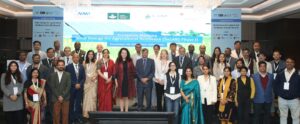
Participants at the India Inception Meeting for Phase II of the SoLAR project, held in New Delhi. Photo: IWMI
Solar-powered irrigation is gaining momentum across South Asia and East Africa to meet rising energy demands, sustainable use of groundwater resources, and reduce rural emissions. Building on its initial successes, Phase II of the Solar Energy for Agricultural Resilience (SoLAR) project expands the programme’s scope to East Africa while deepening its focus on creating an enabling ecosystem for sustainable solar solutions that improve farmer livelihoods and advance clean energy transitions across regions.
Setting the stage: from phase I achievements to phase II ambition
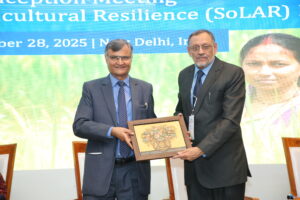
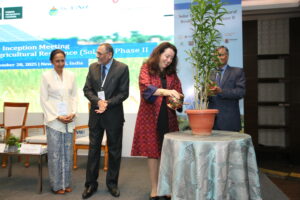
(left)Alok Sikka, Country Representative – India, IWMI, presenting a memento to the Chief Guest, Prof. Ramesh Chand, during the India Inception Meeting of the SoLAR Phase II project in New Delhi. Photo: IWMI (right) H.E. Ms. Maya Tissafi, Ambassador of Switzerland to India and Bhutan, inaugurating the workshop with a symbolic watering of a plant to celebrate the food-water-energy nexus. Photo: IWMI
The Swiss Agency for Development and Cooperation (SDC) supported Phase I of the SoLAR project, that was implemented in South Asia including Bangladesh, India, Pakistan and Nepal by International Water Management Institute from December 2020 to May 2025, demonstrated that well-designed financial incentives linked to grid-connected solar irrigation pumps encourage farmers to conserve groundwater while generating income by selling surplus electricity.
For example, in Bangladesh, pilots have integrated grid-linked solar pumps with innovative financing models to enable farmers, especially women, to increase income-generating activities such as fisheries while using water more sustainably. Similarly, in East Africa specially in Ethiopia, IWMI has been implementing other projects that have emphasized bundling solar irrigation with water-saving practices and community management to enhance climate resilience and equitable access.
These successes across diverse contexts confirm that aligning policy incentives with technology deployment can advance low-carbon agriculture and sustainable water use at scale.
“Drawing on our phase I pilots in Bangladesh, India, Nepal and Pakistan, we have seen that well-designed solar irrigation can raise farmer incomes while cutting diesel use and easing pressure on groundwater,” said Darshini Ravindranath, IWMI’s research group leader for climate policies, finance and processes and SoLAR’s project lead. “When solar pumps are embedded in the right tariffs, business models and training systems, they become a genuine climate solution rather than a new strain on water resources,” she added.
In Kenya and Ethiopia, SoLAR is expanding beyond irrigation to include solar-powered cold storage, dryers and milling equipment that lower costs and reduce post-harvest waste and creates additional source of incomes. Despite vast irrigation potential in Kenya at 3.3 million acres and in Ethiopia at 11 million hectares, challenges such as low coverage of irrigation technologies and ongoing inefficiencies persist.
IWMI supports evidence generation, policy advocacy and financing models for inclusive access. “The two East African countries will benefit from South-South learning with lessons from South Asia adapted to local conditions,” said Muluken Elias Adamseged, IWMI’s deputy country representative in Ethiopia.
Phase II aims to strengthen governance frameworks, unlock public and private investments, and promote business and service delivery models that are socially inclusive, gender-responsive, and climate-resilient. At the launch event of phase II Swiss Ambassador to India and Bhutan Maya Tissafi emphasized, “SDC’s collaboration with IWMI ensures solar energy becomes a source of assurance, opportunity and resilience for rural communities, ensuring that no village, no farmer and no woman is left behind.”
SolaReady dashboard and new partnerships for scaling solutions

Dr. Alok Sikka launching the SolarReady Dashboard, a decision-support tool to support evidence-based planning and scaling of solar irrigation solutions across India, Bangladesh, Kenya, and Ethiopia under SoLAR Phase II. Photo: IWMI
Solar irrigation’s rapid expansion across South Asia and East Africa brings high promise but also complex challenges, ranging from groundwater sustainability to ensuring equitable access and efficient use of resources.
SolarReady is a climate-responsive, user-friendly spatial decision-support platform developed by IWMI to guide where and how solar irrigation can deliver the greatest adaptation, mitigation and groundwater benefits. By integrating water, energy, climate, agricultural and socio-economic data, SolaReady helps policymakers, financial institutes, and investors avoid “one-size-fits-all” solutions and instead adopt context-specific implementation of solar irrigation that contributes toward resilience while preventing groundwater over-extraction.
Beyond the platform itself, SoLAR phase II marks a strategic shift toward embedding these data-driven insights into national implementation programs through meaningful partnerships. The SoLAR Phase II Inception Meeting that was held on 28 November 2025 at New Delhi, India formalized four key agreements focused on strengthening core pillars of the project: policy alignment, capacity building, innovative financing and direct farmer engagement.
Kenya’s Memorandum of Understanding (MoU) between the International Water Management Institute (IWMI) and the Ministry of Water, Sanitation and Irrigation (MoWSI) aims to strengthen irrigation governance, pilot blended-finance models and promote innovation in solar-powered irrigation in support of national development targets. In addition, a sub-agreement with Strathmore University, Kenya, focuses on addressing the country’s growing skills gap by co-designing academic curricula, conducting capacity needs assessments, and facilitating South-South knowledge exchange.
The Memorandum of Understanding with the Ethiopian Solar Energy Development Association (ESEDA) focuses on key areas of engagement, including policy development and capacity building.
Together, these partnerships Phase II to delivers large-scale, responsive and sustainable solar irrigation systems tailored to diverse ecological and institutional contexts.
The Irrigation Secretary of Kenya’s Ministry of Water, Sanitation and Irrigation, Vincent Kabuti, noted that “The collaboration helps us to design practical solar irrigation governance mechanisms and finance models that truly suit farmers’ contexts, accelerating real impact.”
Looking ahead: a shared commitment to climate-resilient agriculture