Category: Blog
Impact of SKY: A Perspective of Women Farmers
By Kriti Sharma, Deepak Varshney, and Darshini Ravindranath The agriculture sector in India, as per the India Energy Outlook, accounts for a staggering 80% of the country’s water demand. Within the total cultivable area, 51% relies on rainfed irrigation while the remaining 49% depends on irrigation systems. Out of the…
What the evidence says about solar irrigation and groundwater sustainability in Bangladesh
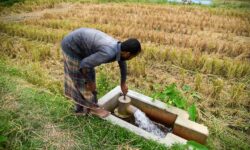
By Tanmoy Bhaduri A farmer opens the water connection pipe to flood his paddy field in Thakurgaon, Bangladesh. The irrigation, supported by a Solar Irrigation Pump (SIP) installed by IDCOL and its partner organization, helps ensure timely water access and improved crop productivity. Photo: Tanmoy Bhaduri/IWMI Solar-powered irrigation systems are…
The next phase of solar energy solutions for agricultural resilience in Asia and Africa
A roadmap for solar irrigation expansion in Ethiopia
By Yonas Tafesse, Amare Haileslassie, Wolde Mekuria, Elizabeth Wamba Agriculture is more than an economic sector in Ethiopia — it is the lifeline of the country. More than 15 million smallholder farmers produce close to 95% of the country’s agricultural output. Their work sustains national food security, supports rural incomes and contributes significantly to economic stability.…
Inclusive financial models empower women in India’s agriculture sector to expand income opportunities
By Tanmoy Bhaduri, Gulshan Borah Agriculture is quietly transforming across rural India — and women are at its heart. As men migrate in search of work due to climate stress, shrinking farm returns and industrial jobs, women are stepping in to manage farms, livestock and households. This feminization of agriculture has been unfolding for years…
Public-private partnerships scale solar-powered agriculture in Bangladesh
By Tanmoy Bhaduri Sumi Mardi from Dinajpur, Bangladesh, explains that because of delayed monsoons, farmers in the region have turned to groundwater irrigation to sustain their livelihoods. Photo: Tanmoy Bhaduri/IWMI As climate change intensifies, Bangladesh’s farmers face the brunt of increasingly unpredictable weather, from prolonged summers to delayed monsoons. Nearly half…
Ethiopia and Kenya to benefit from solar-powered technologies
| By IWMI The International Water Management Institute (IWMI), with funding from the Swiss Agency for Development and Cooperation (SDC), launched the Solar Energy for Agricultural Resilience (SoLAR) project in Ethiopia and Kenya. The project builds on five years of successful work in South Asia, where it proved that solar-powered…
Solarizing will make agriculture resilient in South Asia and East Africa
By Tanmoy Bhaduri Women farmers in Kayumer Char, Gaibandha in northern Bangladesh, lead their cattle home against the backdrop of a movable micro-solar irrigation pump. Photo: Tanmoy Bhaduri / IWMI The International Water Management Institute (IWMI) has launched the second phase of the Solar Energy for Agricultural Resilience (SoLAR) project. Running from…
Closing the Gender Data Gap in Agriculture-Food Systems
By Darshini Ravindranath Angel Konthoujam. Gender equality and social equity are integral to achieving sustainable development in agriculture-food systems, however, achieving said goals has been challenging because of the unique complexities associated with it. Gendered power dynamics are frequently visible in middle- and low-income countries which results in women having…
Impact of SKY: A Perspective of Women Farmers
By Kriti Sharma, Deepak Varshney, and Darshini Ravindranath The agriculture sector in India, as per the India Energy Outlook, accounts for a staggering 80% of the country’s water demand. Within the total cultivable area, 51% relies on rainfed irrigation while the remaining 49% depends on irrigation systems. Out of the…
What the evidence says about solar irrigation and groundwater sustainability in Bangladesh
By Tanmoy Bhaduri A farmer opens the water connection pipe to flood his paddy field in Thakurgaon, Bangladesh. The irrigation, supported by a Solar Irrigation Pump (SIP) installed by IDCOL and its partner organization, helps ensure timely water access and improved crop productivity. Photo: Tanmoy Bhaduri/IWMI Solar-powered irrigation systems are…
The next phase of solar energy solutions for agricultural resilience in Asia and Africa
A roadmap for solar irrigation expansion in Ethiopia
By Yonas Tafesse, Amare Haileslassie, Wolde Mekuria, Elizabeth Wamba Agriculture is more than an economic sector in Ethiopia — it is the lifeline of the country. More than 15 million smallholder farmers produce close to 95% of the country’s agricultural output. Their work sustains national food security, supports rural incomes and contributes significantly to economic stability.…
Inclusive financial models empower women in India’s agriculture sector to expand income opportunities
By Tanmoy Bhaduri, Gulshan Borah Agriculture is quietly transforming across rural India — and women are at its heart. As men migrate in search of work due to climate stress, shrinking farm returns and industrial jobs, women are stepping in to manage farms, livestock and households. This feminization of agriculture has been unfolding for years…
Public-private partnerships scale solar-powered agriculture in Bangladesh
By Tanmoy Bhaduri Sumi Mardi from Dinajpur, Bangladesh, explains that because of delayed monsoons, farmers in the region have turned to groundwater irrigation to sustain their livelihoods. Photo: Tanmoy Bhaduri/IWMI As climate change intensifies, Bangladesh’s farmers face the brunt of increasingly unpredictable weather, from prolonged summers to delayed monsoons. Nearly half…
Ethiopia and Kenya to benefit from solar-powered technologies
| By IWMI The International Water Management Institute (IWMI), with funding from the Swiss Agency for Development and Cooperation (SDC), launched the Solar Energy for Agricultural Resilience (SoLAR) project in Ethiopia and Kenya. The project builds on five years of successful work in South Asia, where it proved that solar-powered…
Solarizing will make agriculture resilient in South Asia and East Africa
By Tanmoy Bhaduri Women farmers in Kayumer Char, Gaibandha in northern Bangladesh, lead their cattle home against the backdrop of a movable micro-solar irrigation pump. Photo: Tanmoy Bhaduri / IWMI The International Water Management Institute (IWMI) has launched the second phase of the Solar Energy for Agricultural Resilience (SoLAR) project. Running from…
Closing the Gender Data Gap in Agriculture-Food Systems
By Darshini Ravindranath Angel Konthoujam. Gender equality and social equity are integral to achieving sustainable development in agriculture-food systems, however, achieving said goals has been challenging because of the unique complexities associated with it. Gendered power dynamics are frequently visible in middle- and low-income countries which results in women having…