
Phase 2
The Solar Energy for Agricultural Resilience (SoLAR) Phase II project builds on the successes and lessons of Phase I (Dec 2019– May 2025) in South Asia and expands its scope to East Africa. Supported by the Swiss Agency for Development and Cooperation (SDC) and implemented by the International Water Management Institute (IWMI) . The program aims to strengthen the enabling environment and unlock investments for sustainable scaling of socially inclusive and climate-resilient solar agri tech solutions in South Asia (India, Bangladesh) and East Africa (Ethiopia, Kenya). Solar Phase 2 will be implemented in partnership with government and implementing agencies who have the mandate to implement policies and programs on solar energy for agriculture. The project runs from July 2025 till December 2028.
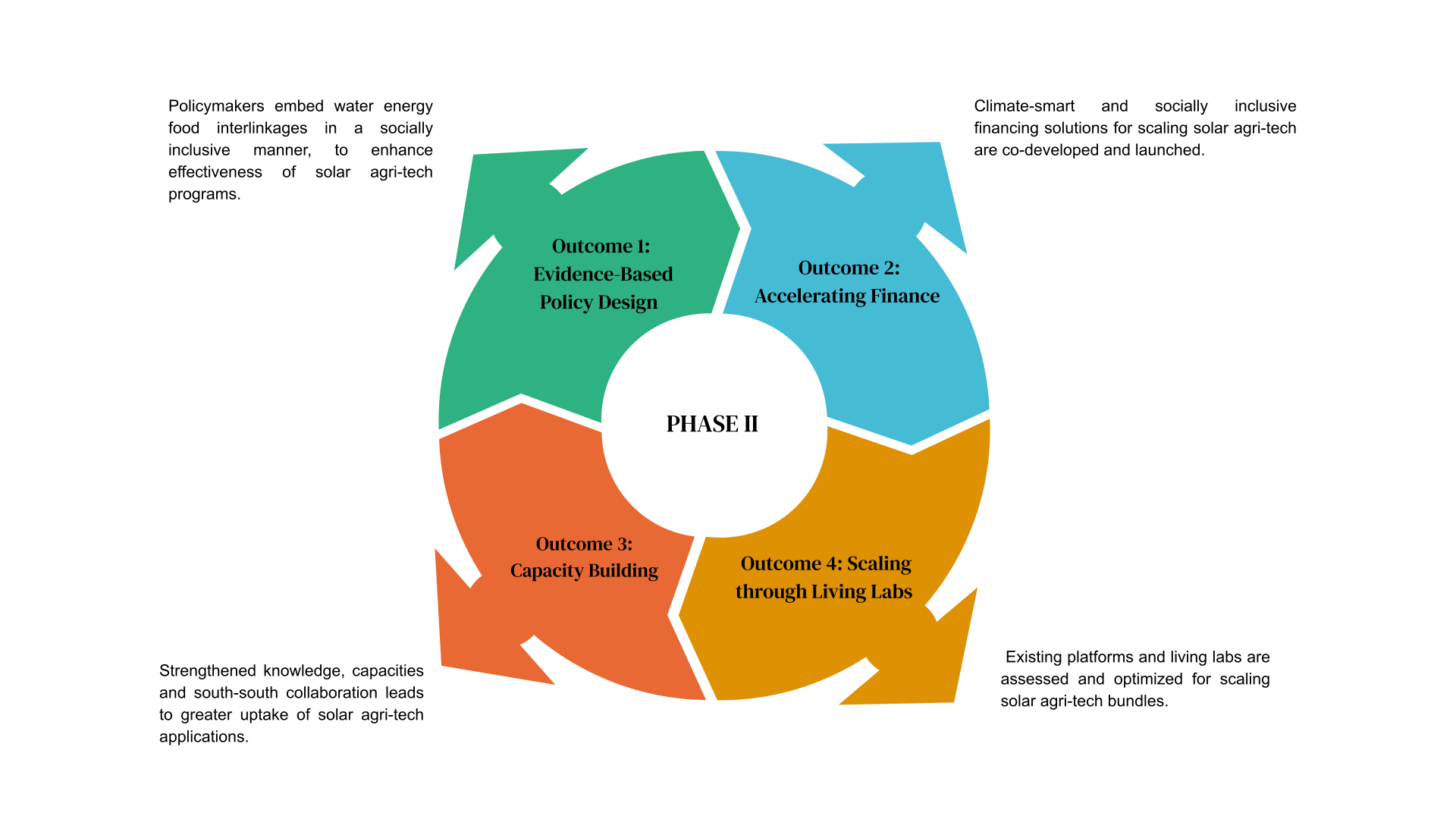
Project Phase II Outcomes
 Where we work
Phase I research showed that grid-connected solar pumps increased farmer incomes by about 34 percent and encouraged crop diversification. The project also supported gender inclusion by improving women’s access to solar irrigation and by integrating Gender Equality and Social Inclusion (GESI) considerations into subsidy schemes. India’s solar irrigation sector is expanding rapidly. The Pradhan Mantri Kisan Urja Suraksha evam Utthaan Mahabhiyan (PM-KUSUM) programme is the main driver of this growth and aims to add about 34,800 megawatts (MW) of solar capacity by 2026. The programme continues to evolve, but it remains central to the large-scale adoption of solar irrigation pumps in the country. Under Phase II, work in India focuses on developing evidence-based policy tools linked to the Water–Energy–Food (WEF) nexus, testing climate-smart financing models for smallholder and marginal farmers, building capacities through specialised training linked to PM-KUSUM, and establishing living laboratories to test bundled solar applications that improve agriculture and rural livelihoods. The project intends to collaborate with institutions such as the Ministry of New and Renewable Energy (MNRE), the National Bank for Agriculture and Rural Development (NABARD), and the Indian Council of Agricultural Research (ICAR) to support the scaling of solar energy solutions that promote social inclusion and climate resilience. Ongoing monitoring and evaluation efforts continue to inform scaling strategies. In line with India’s renewable energy goals and rural development priorities, Solar Energy for Agricultural Resilience (SoLAR) Phase II aims to provide the technical and policy support needed for the sustainable and equitable expansion of solar irrigation. Phase 1 research demonstrated that solar-powered irrigation pumps in Bangladesh reduce irrigation costs by up to 30%, save time, and enhance energy security by replacing imported diesel. Bangladesh is an important focus under SoLAR Phase 2 due to its large agricultural sector and increasing pressure on water and energy resources. The country aims to gradually replace diesel pumps, where the Swiss Agency for Development and Cooperation (SDC) Solar project contributes by providing evidence-based policy guidance and by piloting inclusive financing models that support smallholder adoption of solar irrigation. Phase 2 activities include the development of Water, Energy, Food and Solar Suitability (WEF SS) maps, capacity building for government officials and farmers, and testing bundled solar agricultural technologies. The project is also working on new financing mechanisms targeted at marginal and women farmers. Pilot initiatives assess the feasibility of grid-connected solar pumps and their integration within existing irrigation systems. SoLAR works with government agencies, private sector partners, and local non-governmental organizations such as the Bangladesh Agricultural Development Corporation (BADC), Infrastructure Development Company Limited (IDCOL), Department of Agricultural Extension (DAE), and the Barind Multipurpose Development Authority (BMDA) to improve awareness, address groundwater sustainability challenges, and ensure that the expansion of solar irrigation is aligned with Bangladesh’s Nationally Determined Contributions (NDCs) and National Adaptation Plan (NAP). Ethiopia has joined SoLAR Phase 2 at a time when the country is expanding its focus on clean irrigation solutions. Agriculture remains a major part of Ethiopia’s economy, and solar irrigation is increasingly seen as a viable option to support rural livelihoods. The project works with the Ministry of Agriculture (MoA), the Agricultural Transformation Institute (ATI), and local enterprises such as Green Scene Energy (GSE) to strengthen on-ground implementation and the overall enabling environment. Under Phase 2, activities include supporting the integration of solar irrigation into national programmes and testing gender inclusive financing and business models. The project is also generating on-field evidence through pilot demonstrations. Capacity building for regional officers and work on sustainable groundwater use form another important part of the programme, as these are essential for long-term solar irrigation expansion. Through innovation and knowledge sharing platforms, SoLAR Phase 2 aims to support Ethiopia in improving food security, advancing climate adaptation, and promoting sustainable electrification of irrigated agriculture. Kenya is an important country for SoLAR Phase 2 in East Africa, where solar irrigation is seen as a promising way to improve agricultural productivity for smallholder farmers. The team has ongoing work with the National Irrigation Authority (NIA) and the Rural Electrification and Renewable Energy Corporation (REREC), along with private companies such as SunCulture Kenya and FuturePump which will be built upon through solar phase 2. Phase 2 activities include piloting inclusive financing models for solar irrigation, carrying out impact and feasibility studies, and building the skills of extension workers and community trainers. Living lab pilots are testing packages of solar technologies, for example pairing solar pumps with solar dryers and cold storage, to help farmers increase their incomes and strengthen their resilience to climate impacts. The project also takes part in national forums and discussions to support knowledge sharing and to align its work with Kenya’s irrigation and clean energy goals. These efforts aim to develop solar irrigation approaches that can be scaled and adapted across sub–Saharan Africa. Partners Infrastructure Development Company Limited (IDCOL), Bangladesh Department of Agricultural Extension (DAE), Bangladesh Bangladesh Agricultural Development Corporation (BADC), Bangladesh Sustainable and Renewable Energy Development Authority (SREDA), Bangladesh Barind Multipurpose Development Authority (BMDA) NGO Forum Bangladesh Agricultural Research Council (BARC) Ministry of New and Renewable Energy (MNRE), India Indian Council of Agriculture Research (ICAR), India Uttar Pradesh New and Renewable Energy Development Agency (UPNEDA), India National Bank for Agriculture and Rural Development (NABARD), India Power Finance Corporation (PFC) & Indian Renewable Energy Development Agency (IREDA), India Gujarat Energy Research & Management Institute (GERMI), India Gujarat Urja Vikas Nigam Limited (GUVNL), India Ministry of Agriculture (MoA), Ethiopia Agricultural Transformation Institute (ATI), Ethiopia Green Scene Energy (GSE), Ethiopia– Ethiopian Solar Energy Development Association (ESEDA), Ethiopia– GOGLA – GOGLA is working in Ethiopia to accelerate Productive Use of Renewable Energy (PURE) by supporting a sustainable industry ecosystem through three strategic pillars: convening stakeholders, influencing policy & finance, and informing members with data/standards Agri-Energy Coalition – The Agri-Energy- Coalition is a global alliance of partners working on energy, water, agriculture, nutrition, climate and finance; created to unlock the potential of agri-food systems with clean energy. SunCulture Kenya – GOGLA – GOGLA is working in Kenya to accelerate Productive Use of Renewable Energy (PURE) by supporting a sustainable industry ecosystem through three strategic pillars: convening stakeholders, influencing policy & finance, and informing members with data/standards Agri-Energy Coalition – The Agri-Energy– Coalition is a global alliance of partners working on energy, water, agriculture, nutrition, climate and finance; created to unlock the potential of agri-food systems with clean energy. FuturePump, Kenya CLASP, Kenya Strathmore University, Kenya – National Irrigation Authority (NIA), Kenya State Department of Irrigation (SDI) – Under the new National Irrigation Sector Investment Plan (NISIP), SDI is prioritizing Farmer-Led Irrigation Development (FLID), in which solar pumping is a central component. Rural Electrification and Renewable Energy Corporation (REREC), Kenya
Infrastructure Development Company Limited (IDCOL) is a government-owned financial institution established in 1997. IDCOL is Bangladesh’s primary solar irrigation financier and the anchor organization for scaling SoLAR pilots, innovative financing models, and mainstreaming solar pumps in agriculture. Their partnerships span government ministries, SREDA, NGOs, private sector, and farming communities.
DAE, the largest government extension service provider, spearheads farmer training, field demonstrations, and grassroots outreach. DAE’s collaboration ensures SoLAR’s technical, social inclusion, and capacity-building objectives reach a wide range of farmers, particularly women and marginalized groups.
BADC is the Ministry of Agriculture’s key institution for irrigation. In SoLAR Phase 2, BADC provides knowledge, implementation support for minor irrigation schemes, and valuable policy research collaboration.
SREDA is the national regulatory authority for renewables. SREDA’s policy and regulatory guidance is essential for mainstreaming SoLAR findings at the national level.
BMDA supports irrigation development, particularly in the Barind region, collaborating on pilot projects and solar irrigation expansion.
NGO Forum works alongside government and development partners to support community-level adoption and sustainable practices for solar agri-tech.
BARC provides research support and collaborates on innovations to improve the effectiveness and adoption of solar irrigation technologies.
MNRE leads India’s solar policy, implementing national programs such as PM KUSUM. In SoLAR Phase 2, MNRE provides high-level guidance, ensures policy convergence, and supports solar scheme expansion in agriculture.
Find out more about MNRE
ICAR extends SoLAR’s reach through technical support, research, and farmer education, integrating SIPs into mainstream agricultural extension and innovation.
UPNEDA implements and tests SIP pilot models in Uttar Pradesh, supporting institutional mechanisms and state-level capacity building.
NABARD designs and delivers financial solutions for smallholder farmers to adopt SIPs.
PFC and IREDA finance infrastructure and renewable energy adoption, scaling up SIP impact.
GERMI is a leader in climate-smart solar innovation, collaborating on research, training, and SKY implementation.
GUVNL is Gujarat’s leading energy distribution agency, critical for large-scale solar pilot execution and evaluation.]
MoA is Ethiopia’s central government agency for agricultural development. MoA leads projects like PACT and FSRP, leveraging SoLAR to expand access to efficient irrigation and solar innovation.
ATI partners with SoLAR to develop and mainstream science-based solar irrigation and water management solutions for smallholders.
Green Scene Energy is a women-led leader in solar distribution, providing PAY-Go and mini-grid solutions and supporting large-scale pilots for productive use in Phase 2.
ESEDA fosters a vibrant solar industry through networking, policy engagement, and training, empowering local solar businesses.
SunCulture is Kenya’s leading provider of smart solar irrigation, with Pay-As-You-Grow financing models and comprehensive farmer support.
FuturePump designs and manufactures solar water pumps tailored to the needs of small farms, driving fuel-free irrigation innovation.
CLASP advances clean energy appliance markets and capacity, supporting end-user education and efficient solar equipment deployment.
Strathmore University creates training curricula, builds capacity for solar systems installation and maintenance, and supports research on solar’s impact in agriculture.
NIA develops and implements Kenya’s irrigation schemes, ensuring national reach and technical expertise for SoLAR’s irrigation scale-up.
REREC powers Kenya’s rural renewable energy programs, including off-grid solar access for agriculture.