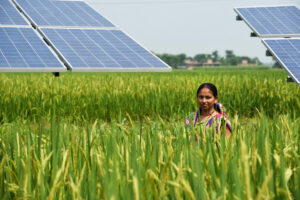
Priyanka Devi, a 30-year-old woman farmer in Bochaha Block, Muzaffarpur District, Bihar, India, recently installed a solar irrigation pump on her farm. Sept. 27, 2023. Photo: Tanmoy Bhaduri/IWMI.
Phase I research in India showed that grid-connected solar pumps increased farmer incomes by about 34 percent and encouraged crop diversification. The project also supported gender inclusion by improving women’s access to solar irrigation and by integrating Gender Equality and Social Inclusion (GESI) considerations into subsidy schemes.
India’s solar irrigation sector is expanding rapidly. The Pradhan Mantri Kisan Urja Suraksha evam Utthaan Mahabhiyan (PM-KUSUM) programme is the main driver of this growth and aims to add about 34,800 megawatts (MW) of solar capacity by 2026. The programme continues to evolve, but it remains central to the large-scale adoption of solar irrigation pumps in the country.
Under Phase II, work in India focuses on developing evidence-based policy tools linked to the Water–Energy–Food (WEF) nexus, testing climate-smart financing models for smallholder and marginal farmers, building capacities through specialised training linked to PM-KUSUM, and establishing living laboratories to test bundled solar applications that improve agriculture and rural livelihoods.
The project intends to collaborate with institutions such as the Ministry of New and Renewable Energy (MNRE), the National Bank for Agriculture and Rural Development (NABARD), and the Indian Council of Agricultural Research (ICAR) to support the scaling of solar energy solutions that promote social inclusion and climate resilience. Ongoing monitoring and evaluation efforts continue to inform scaling strategies. In line with India’s renewable energy goals and rural development priorities, Solar Energy for Agricultural Resilience (SoLAR) Phase II aims to provide the technical and policy support needed for the sustainable and equitable expansion of solar irrigation.
Partners :
Ministry of New and Renewable Energy (MNRE), India
MNRE leads India’s solar policy, implementing national programs such as PM KUSUM. In SoLAR Phase 2, MNRE provides high-level guidance, ensures policy convergence, and supports solar scheme expansion in agriculture.
Find out more about MNRE
Indian Council of Agriculture Research (ICAR), India
ICAR extends SoLAR’s reach through technical support, research, and farmer education, integrating SIPs into mainstream agricultural extension and innovation.
Uttar Pradesh New and Renewable Energy Development Agency (UPNEDA), India
UPNEDA implements and tests SIP pilot models in Uttar Pradesh, supporting institutional mechanisms and state-level capacity building.
National Bank for Agriculture and Rural Development (NABARD), India
NABARD designs and delivers financial solutions for smallholder farmers to adopt SIPs.
Power Finance Corporation (PFC) & Indian Renewable Energy Development Agency (IREDA), India
PFC and IREDA finance infrastructure and renewable energy adoption, scaling up SIP impact.
Gujarat Energy Research & Management Institute (GERMI), India
GERMI is a leader in climate-smart solar innovation, collaborating on research, training, and SKY implementation.
Gujarat Urja Vikas Nigam Limited (GUVNL), India
GUVNL is Gujarat’s leading energy distribution agency, critical for large-scale solar pilot execution and evaluation.]
Publications:
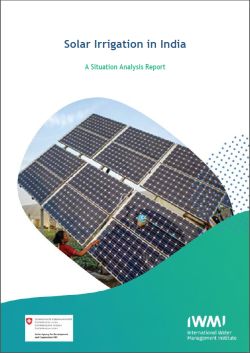
A situation analysis report to understand the synthesis of India’s solar irrigation policies.
India’s solar irrigation policies are examined in this report, focusing on the nation’s transition to renewable energy and the challenges faced by the water and energy sectors concerning solar irrigation. The SDC-SoLAR project, led by the IWMI, aims to address these issues through research activities. Groundwater-led irrigation played a significant role in India’s agricultural success, but it led to unsustainable groundwater use and environmental consequences. To mitigate emissions, India plans to install 175 GW of renewable energy by 2022, with a major focus on solar energy. Solar-powered irrigation, though a minor part of this plan, can contribute to India’s clean energy transition with proper policies.
Several reforms have been introduced over the last decade to promote solar irrigation, including the PMKUSUM scheme. However, barriers remain, such as financial challenges for electricity distribution companies, incentivizing farmers, and technical hurdles. Sustainable groundwater management and inclusive deployment of solar pumps are also crucial aspects that need attention. The Gujarat-based SKY scheme offers insights into grid-connected solar irrigation. The SoLAR project aims to evaluate its impact on energy usage, water pumping, farming practices, and farmers’ income.
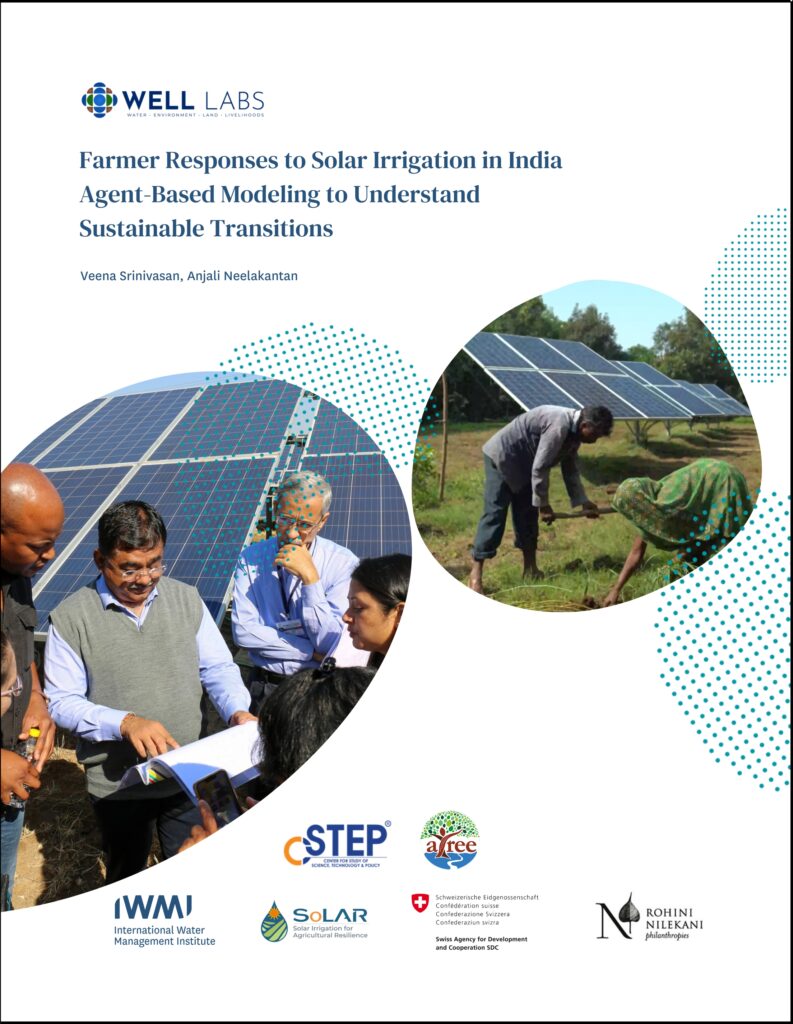
Farmer Responses to Solar Irrigation in India
Agent-Based Modeling to Understand Sustainable Transitions
WELL-LABS
Solar irrigation in India aims to address irrigation access and groundwater overexploitation. Many Indian farmers rely on rainfall, making them vulnerable to climate variability and limiting their crop options. Solar irrigation offers the potential to increase irrigation access for farmers without grid connections or expensive diesel pump sets while curbing groundwater abstraction through net metering.
Agent-based modeling (ABM) was used to understand farmer choices and transitions before and after solar irrigation. The study suggests that sustainable transitions are physically possible, but deep lock-ins in agriculture and biophysical constraints limit changes. Case studies in different regions highlight specific challenges and potential outcomes.
For solar irrigation to bring true change and crop diversification, sociotechnical evolutions are necessary, including changes in agricultural and energy policies. It is crucial to examine local contexts and apply the ABM approach accordingly to make a significant and lasting impact on groundwater sustainability and farmer incomes.
This report provides valuable insights into the complexities of implementing solar irrigation in India and the need for context-specific strategies to achieve desired outcomes.
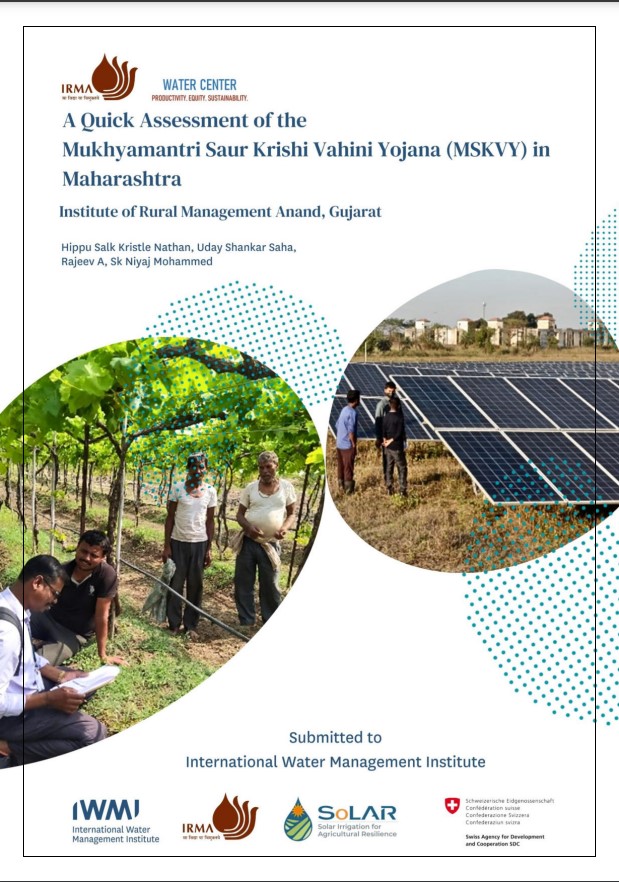 A Quick Assessment of the Mukhyamantri Saur Krishi Vahini Yojana (MSKVY) in Maharashtra-IRMA
Solar irrigation in India aims to tackle issues of irrigation access and groundwater overexploitation. Many Indian farmers rely on rainfall, leaving them susceptible to climate fluctuations and restricting their crop choices. Solar irrigation presents an opportunity to expand irrigation access for farmers lacking grid connections or costly diesel pump sets, all while mitigating groundwater extraction through net metering.
To comprehend the choices and transitions of farmers concerning solar irrigation, agent-based modeling (ABM) was employed. The research indicates that sustainable shifts are feasible, but entrenched agricultural practices and environmental constraints hinder progress. Through case studies in various regions, specific challenges and potential outcomes are highlighted.
For solar irrigation to bring about substantial change and crop diversification, sociotechnical transformations are imperative. This entails revising agricultural and energy policies to align with local circumstances and implementing ABM appropriately. By doing so, a substantial and enduring impact on groundwater sustainability and farmer incomes can be achieved. This report offers valuable insights into the intricacies of implementing solar irrigation in India, underscoring the necessity for tailored strategies to attain desired objectives.